Laravel, Vue.js, and modern web apps that scale
A clear framework for choosing PHP, Laravel, Vue.js, and API-first architecture for durable, maintainable digital products.
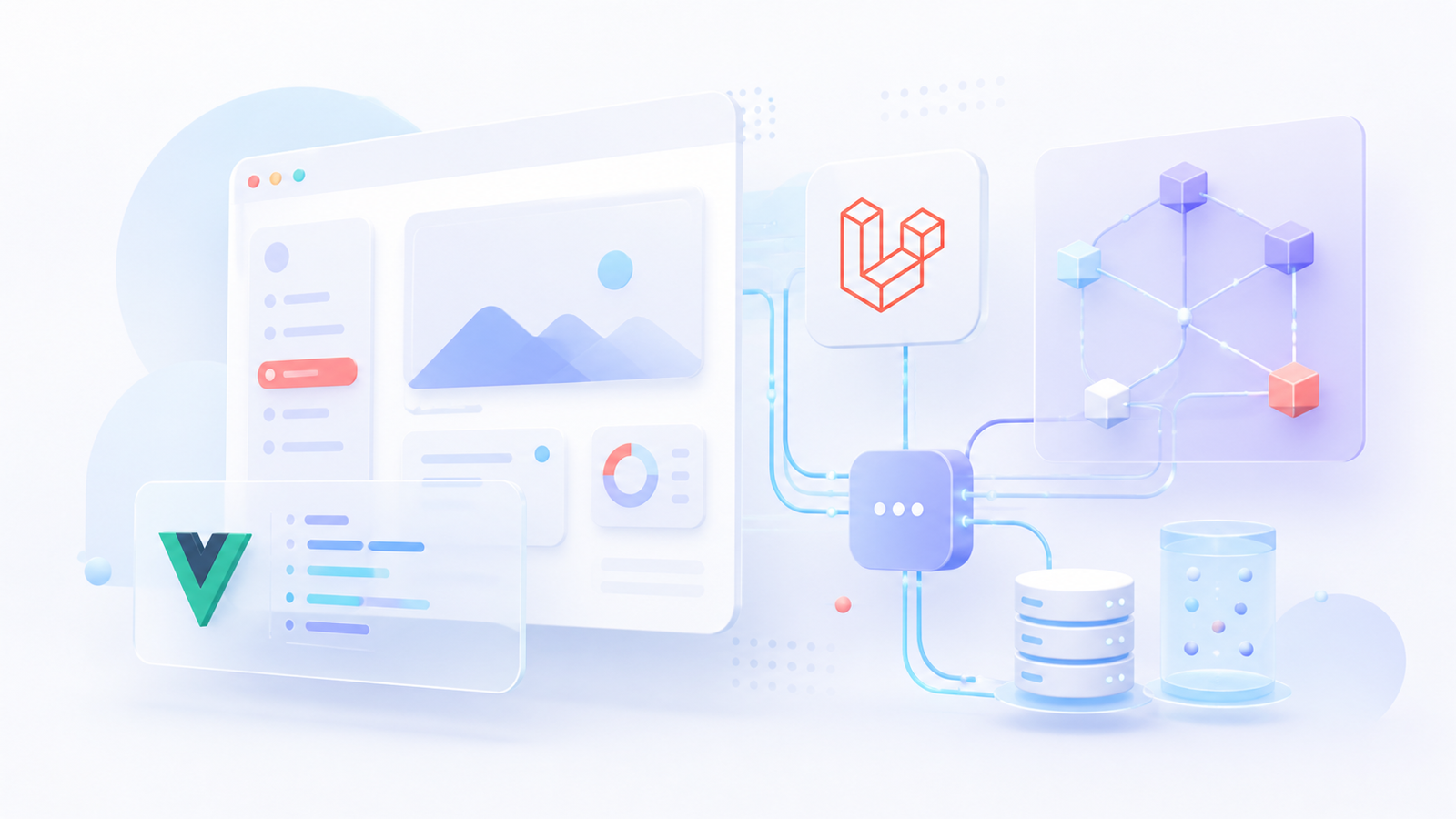
Laravel and Vue.js make a strong modern web application stack when teams need fast product delivery, clear domain logic, interactive interfaces, and a mature PHP ecosystem. The best architecture separates responsibilities without adding complexity the product does not need.
Key takeaways
- Choose architecture around product complexity, team capability, and growth plans.
- Use Laravel for domain logic, APIs, queues, jobs, and secure application foundations.
- Use Vue.js where interaction benefits from component-based frontend behaviour.
- Invest early in testing, observability, deployment automation, and accessibility.
When Laravel and Vue.js are a good fit
Laravel is a productive PHP framework for authentication, routing, validation, queues, events, scheduled tasks, and business workflows. Vue.js adds a focused component model for rich dashboards, portals, commerce experiences, and internal tools.
Together they work well for SaaS products, marketplaces, education platforms, healthcare portals, event systems, and enterprise applications where speed and long-term maintainability both matter.
Create clear boundaries between the app layers
Keep domain rules on the server, expose deliberate API contracts, and let the frontend focus on interaction and presentation. Shared validation, typed payloads, consistent errors, and versioned contracts reduce friction as teams grow.
For smaller products, a Laravel monolith with Vue components can be the fastest path. Split services only when an independent scaling, ownership, or reliability boundary justifies the operational cost.
Build quality into the delivery loop
Automated feature tests, API tests, browser tests, static analysis, and code review protect speed as the codebase grows. Add performance budgets for key pages, database query monitoring, queue visibility, and structured application logs before the first major traffic spike.
Continuous integration should run migrations safely, build frontend assets, scan dependencies, and deploy repeatably. These practices matter whether the product is serving customers in India or users across the UK, UAE, and Australia.
Plan for the next stage of scale
Start with a simple deployment and make scaling options explicit: Redis for queues and caching, object storage for files, read replicas for database pressure, background jobs for slow work, and a CDN for global assets.
Document the decisions and ownership model. A durable application is one a new engineer can understand, monitor, change, and release confidently months after the first launch.
Frequently asked questions
Is Laravel suitable for enterprise applications?+
Yes. Laravel provides a mature foundation for secure, tested, observable enterprise applications, especially when paired with clear domain boundaries, deployment automation, and strong engineering practices.
Should every Laravel application use Vue.js?+
No. Vue.js is useful when the interface needs rich component interaction. A server-rendered Laravel application may be simpler and faster for content-heavy or workflow-focused products.
Can Navista modernise an existing PHP application?+
Yes. Modernisation can be incremental: stabilise tests, improve security, extract APIs where useful, upgrade dependencies, refresh the frontend, and improve deployment without rewriting everything at once.